September 2026
SPARK: Seminar Platform for Adaptive Resilience Knowledge
Concluded [September 25, 2026]
Join us for our next seminar:
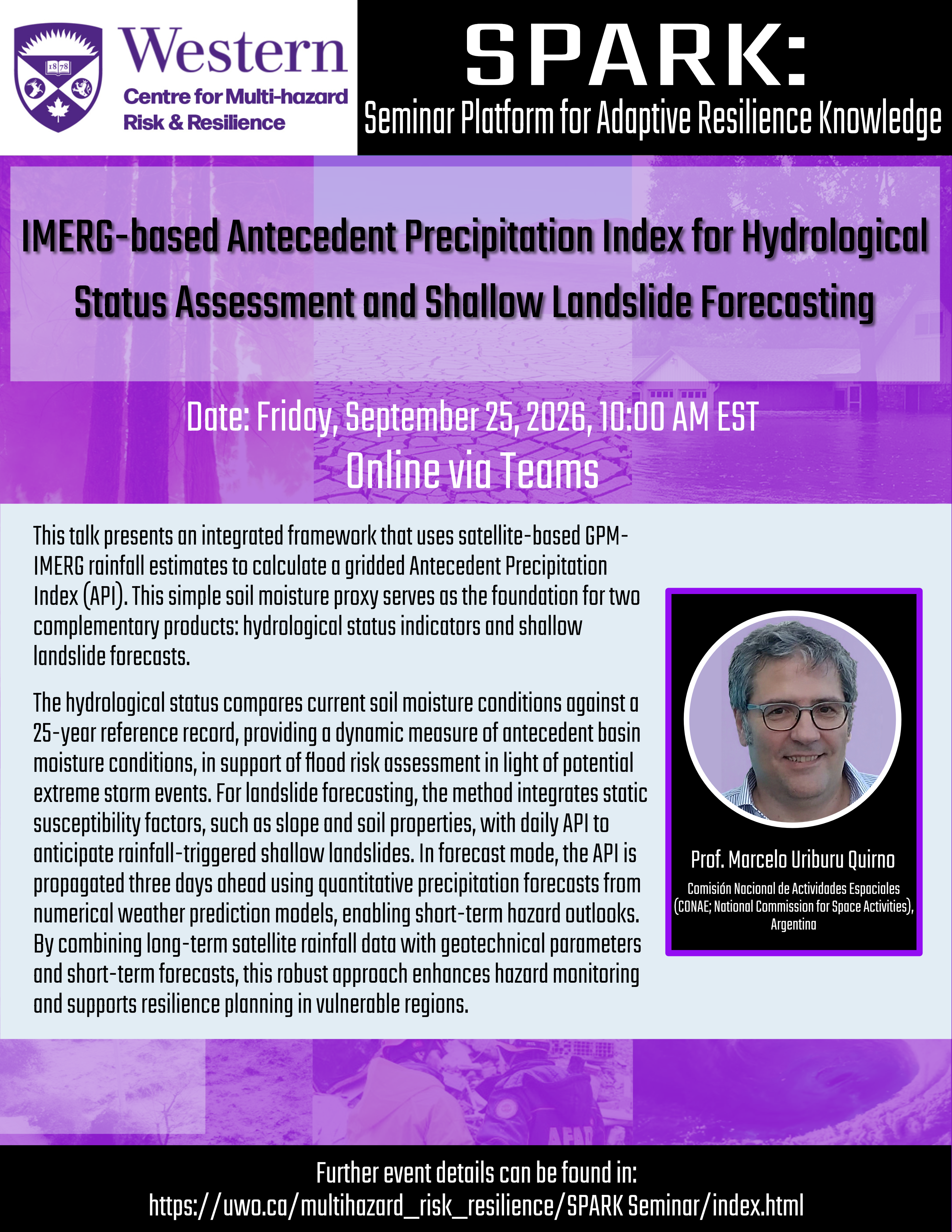
IMERG-based Antecedent Precipitation Index for Hydrological Status Assessment and Shallow Landslide Forecasting
Abstract
This talk presents an integrated framework that uses satellite-based GPM-IMERG rainfall estimates to calculate a gridded Antecedent Precipitation Index (API). This simple soil moisture proxy serves as the foundation for two complementary products: hydrological status indicators and shallow landslide forecasts.
The hydrological status compares current soil moisture conditions against a 25-year reference record, providing a dynamic measure of antecedent basin moisture conditions, in support of flood risk assessment in light of potential extreme storm events. For landslide forecasting, the method integrates static susceptibility factors, such as slope and soil properties, with daily API to anticipate rainfall-triggered shallow landslides. In forecast mode, the API is propagated three days ahead using quantitative precipitation forecasts from numerical weather prediction models, enabling short-term hazard outlooks. By combining long-term satellite rainfall data with geotechnical parameters and short-term forecasts, this robust approach enhances hazard monitoring and supports resilience planning in vulnerable regions.
Date/Time: Friday, September 25, 2026, 10:00 AM EST
Speaker: Prof. Marcelo Uriburu Quirno
Comisión Nacional de Actividades Espaciales (CONAE; National Commission for Space Activities), Argentina
Concluded [September 11, 2026]
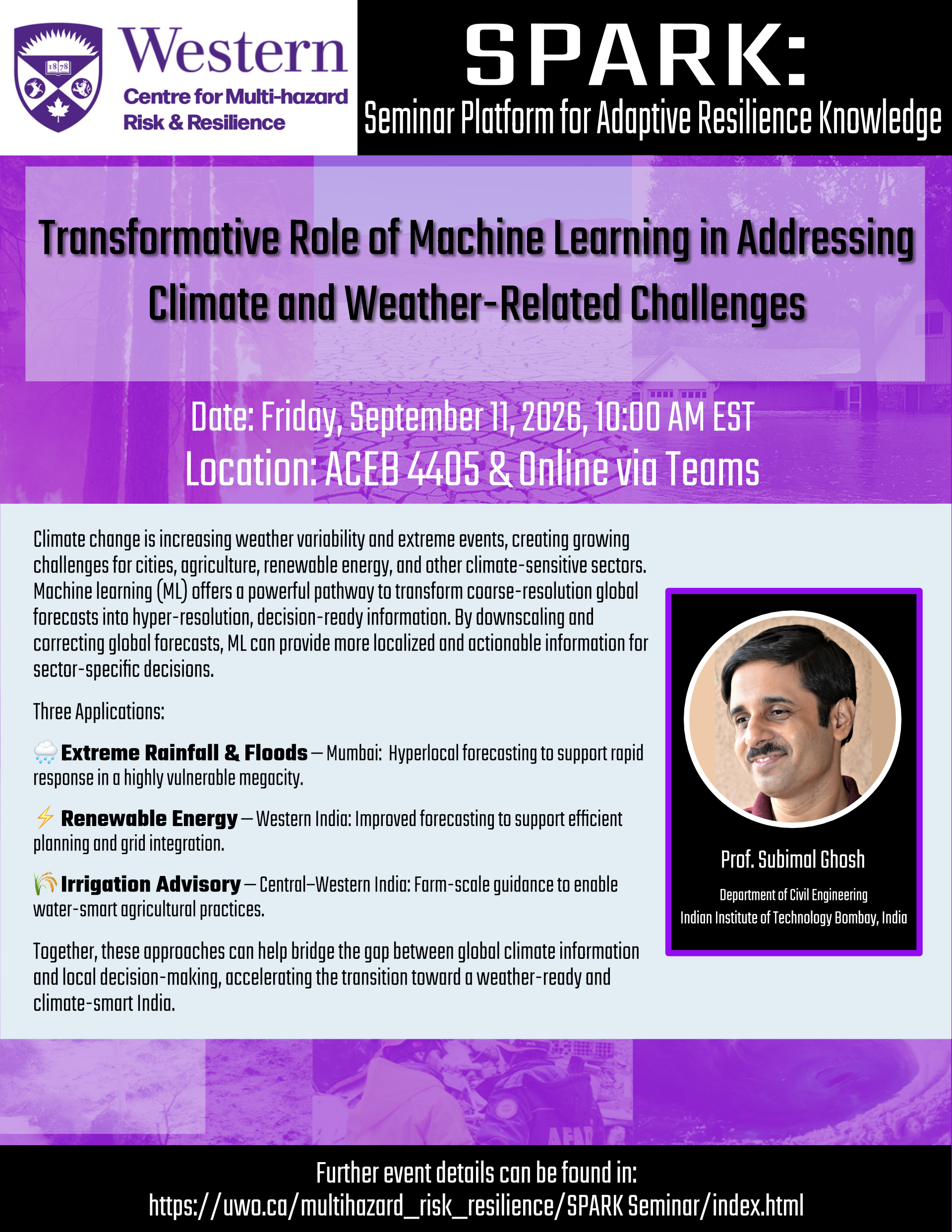
Transformative Role of Machine Learning in Addressing Climate and Weather-Related Challenges
Abstract
Climate change is driving increasingly irregular weather patterns and a rise in extreme events, placing significant stress on urban infrastructure, agriculture, renewable energy systems, and other climate-sensitive sectors. Although physics-based forecasting models have advanced considerably over the past decade, they remain computationally intensive and often exhibit systematic biases, large uncertainties, and challenges in representing extremes. In this talk, I will demonstrate how state-of-the-art machine learning approaches can transform coarse-resolution global forecasting systems into hyper-resolution, decision-ready products tailored for sectoral applications. By intelligently downscaling and correcting global forecasts, these tools bridge the critical gap between large-scale climate information and local-scale decision needs. I will highlight three co-developed, stakeholder-driven applications:
- A hyperlocal extreme rainfall and flood forecasting system for Mumbai, enabling rapid response in a highly vulnerable megacity.
- A renewable energy forecasting framework for Western India, supporting efficient planning and grid integration.
- A farm-scale irrigation advisory system for central–western India, designed to guide water-smart agricultural practices.
Date/Time: Friday, September 11, 2026, 10:00 AM EST
Speaker: Prof. Subimal Ghosh
Department of Civil Engineering
Indian Institute of Technology Bombay, India